
Zero Trust Architecture: Replacing Perimeter Security in Modern Cybersecurity
In today’s threat landscape, Zero Trust Architecture (ZTA)—as defined in NIST SP 800-207—marks a paradigm shift in cybersecurity. Traditional perimeter-based models fail against insider threats, remote work, and cloud breaches. Zero Trust eliminates implicit trust, verifying every access request no matter the source.
This guide explores Zero Trust vs traditional perimeter security, its core principles, implementation steps per NIST guidelines, and proven benefits. Discover how ZTA reduces your attack surface by up to 50% (per Forrester research).
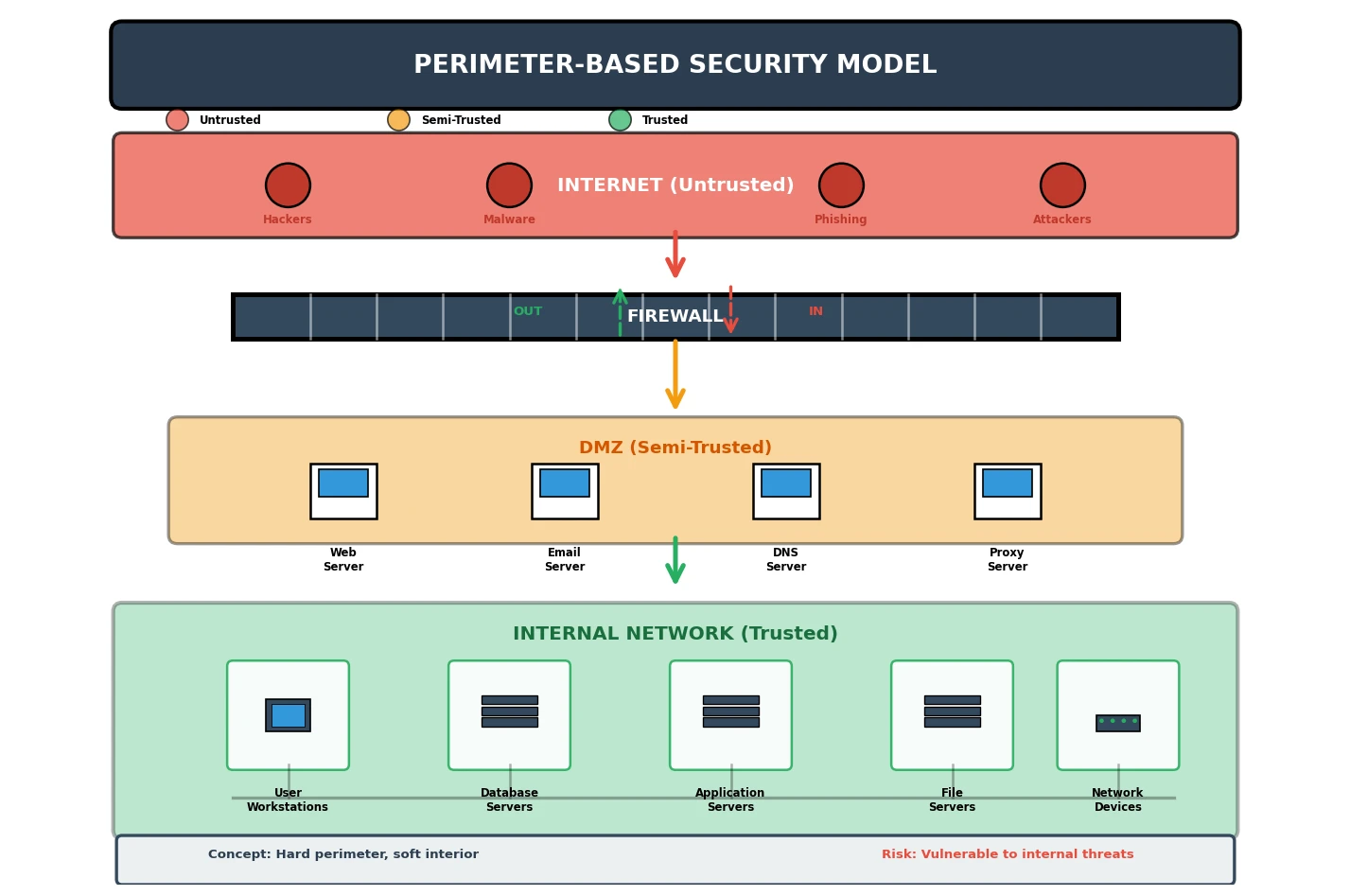
Traditional Perimeter-Based Security Model Diagram of traditional perimeter-based security model with firewall and trusted internal network.
Flaws of Traditional Perimeter-Based Security 🛡️
Think of perimeter security like a medieval castle: a moat (firewall) and drawbridge (VPN) keep outsiders out, but once inside, everyone roams freely. This model crumbles under modern attacks.
Key Characteristics
- Robust external defenses like firewalls and VPNs.
- Implicit trust for internal users and devices.
- Poor visibility into internal traffic.
- Reliance on single failure points, such as one firewall.
Critical Limitations
- Ignores internal threats and lateral movement (e.g., stolen credentials).
- Struggles with remote/hybrid workforces and cloud migrations.
- Complex management leads to misconfigurations.
- Assumes “inside = safe,” despite 80% of breaches involving insiders (Verizon DBIR 2025).
Perimeter security worked in static networks but fails in distributed environments. Transitioning to Zero Trust security addresses these gaps head-on.
Zero Trust Architecture Explained 🤔
Zero Trust Architecture assumes breach at every turn. No user, device, or network segment gets automatic trust. Instead, it continuously verifies identity, context, and behavior for every interaction.
Backed by NIST SP 800-207, ZTA shifts from “trust but verify” to “never trust, always verify.”
NIST Core Principles of Zero Trust
- Assume Breach: Every request could be malicious—act accordingly.
- Verify Explicitly: Use identity, device health, location, and anomaly data for decisions.
- Least Privilege Access: Grant minimal permissions, just-in-time and just-enough.
Essential Zero Trust Elements
- Identity Governance: Multi-factor authentication (MFA), role-based access control (RBAC).
- Endpoint Security: Continuous device posture checks (e.g., EDR tools).
- Network Segmentation: Micro-segmentation to limit blast radius.
- Data Protection: Encrypt data at rest/transit with granular controls.
- Monitoring & Analytics: AI-driven detection for real-time response.
These pillars create a dynamic, resilient framework. For example, a sales rep accessing CRM data from home gets verified via MFA, device compliance, and behavioral analytics—unlike perimeter models.
Implementing Zero Trust: NIST SP 800-207 Roadmap 🚀
NIST SP 800-207 outlines 19 ZTA configurations, from device-agent to enhanced enterprise models. Start small, scale securely.
5-Step Implementation Guide
- Define Strategy: Align ZTA with business goals; assess current maturity via tools like Forrester’s Zero Trust eXtended (ZTX).
- Map & Classify Assets: Inventory data, apps, and flows; prioritize high-value targets.
- Deploy Authentication: Roll out MFA, SSO, and passwordless options enterprise-wide.
- Segment & Monitor: Use SDP (Software-Defined Perimeter) for traffic control; integrate SIEM for logging.
- Iterate & Automate: Run simulations, measure via KPIs (e.g., mean time to detect), and refine with policy engines.
Pro tip: Pilot with one workload, like email or SaaS apps, before full rollout. Tools like Zscaler, Palo Alto Prisma, or Okta accelerate adoption.
Benefits of Zero Trust Architecture 🌟
Organizations adopting ZTA report transformative results:
- Reduced Attack Surface: Limits lateral movement, containing 70% more breaches (Gartner).
- Faster Incident Response: Real-time visibility cuts MTTR by 50%.
- Compliance Edge: Meets GDPR, HIPAA, and CMMC via built-in auditing.
- Scalability for Cloud/Hybrid: Supports remote work without VPN bottlenecks.
- Cost Savings: Up to 25% lower breach costs (IBM Cost of a Data Breach 2025).
Case study: Google’s BeyondCorp implemented ZTA in 2014, eliminating VPNs and preventing countless breaches.
Why Zero Trust is Essential Now
Cyber threats evolve daily—ransomware, supply chain attacks (e.g., SolarWinds), and AI-driven phishing demand proactive defense. Zero Trust Architecture future-proofs your organization against them.
Ready to shift paradigms? Audit your perimeter today and explore NIST SP 800-207 for tailored guidance.
What’s your biggest cybersecurity challenge? Contact our experts for a free ZTA assessment.